

What Happens to a Child's Brain and Body in 30 Minutes of Swimming
Right now, at training camps across North America, World Cup squads are doing something that might surprise you.
Between matches, between tactical sessions, between the strategy briefings and the press conferences, elite footballers are getting in the pool. Not to train for swimming. To recover, reset, and come back sharper for what comes next.
This is not unique to football. The greatest cricketers in the world do the same thing. And the reasons why tell you something important about what is happening in your child's 30-minute lesson every week.
What do Virat Kohli and Cristiano Ronaldo have in common?
They both use the pool when they are not competing in their sport.
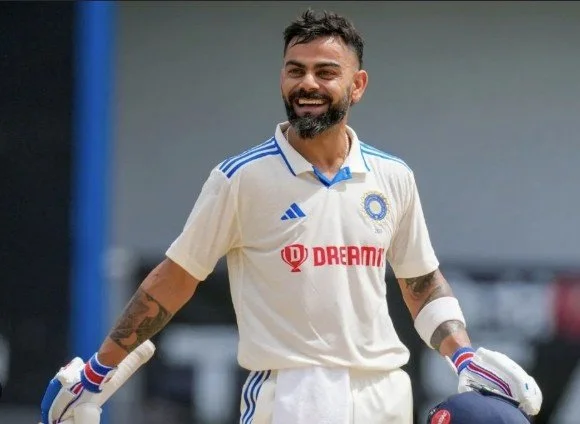
Virat Kohli, widely regarded as the fittest cricketer of his generation, includes swimming as a full-body conditioning tool on active recovery days, rotating it into his training week precisely because it works the whole body without the joint stress that running and gym work accumulate over a long international schedule. For a cricketer carrying the physical load of a full series, that distinction matters enormously.
Cristiano Ronaldo takes this further. After every match, Ronaldo spends 20 minutes in the pool as part of his documented post-match recovery ritual, swimming in complete silence, using the time to process his performance and allow his body to reset. This is not an occasional habit. It is a non-negotiable part of how one of the most decorated athletes in football history prepares to perform again.
Erling Haaland, currently the most clinical striker at the 2026 World Cup, includes swimming as a regular part of his cardiovascular conditioning programme alongside the obsessive recovery protocols that have made him a subject of genuine scientific interest.
Three of the most physically optimised athletes on the planet, across two of the world's most demanding sports, all reach for the same tool.
The question worth asking is why.


What does water do that nothing else can?
When the body is submerged, even partially, the hydrostatic pressure of the water acts on every part of it simultaneously. Blood flow changes. The cardiovascular system responds differently than it does on land. Muscles experience load-free resistance that promotes circulation and recovery without adding stress to joints and tendons already carrying a full training load.
Elite conditioning teams use pool sessions specifically because water provides something no gym or field can: the ability to keep the body moving productively during recovery, rather than shutting it down entirely.
For children, the same mechanism applies, but the benefit is not primarily about recovery from a previous session. It is about what the water builds during the session itself.
Swimming is unusual as a physical activity because it demands bilateral coordination. Both sides of the body work in structured opposition. Both hemispheres of the brain are engaged at the same time. The timing of breath, the rotation of the torso, the coordination of arms and legs across the midline of the body, these require a level of cross-hemisphere neural activity that running, cycling, or most team sports simply do not produce in the same way.
There is also the proprioceptive dimension. Water provides constant resistance from every direction, and the body continuously reads and adjusts to that pressure. This activates sensory and motor pathways that are largely dormant in everyday movement on land. It is part of why children who swim regularly tend to develop refined physical coordination that transfers into other areas of their lives.
Researchers across multiple independent studies in different countries have found the same consistent pattern: children who swim regularly tend to be ahead of peers in measures of executive function. This covers planning, attention, impulse control, and the ability to shift between tasks. The exact mechanism is still being refined in the academic literature, but the pattern is robust enough to be taken seriously.
One session does not produce all of this. The effect is cumulative. Which is where the consistency question becomes the most important one.
What does 30 minutes of swimming do to a child's brain?
Why does 30 minutes, week after week, matter more than people realise?
Think about what Ronaldo's 20-minute post-match swim actually represents. It is not one swim. It is the same discipline, repeated after every match, across a career spanning more than two decades. The habit is inseparable from the outcome.
The same logic applies to a child in a swim school.
A child who swims 40 weeks a year for five years accumulates roughly 100 hours of structured water-based movement. The bilateral coordination, the breath control, the proprioceptive vocabulary, the cardiovascular base, none of these develop in a single term. They are the product of that 100 hours, built quietly and consistently over time.
A child who keeps coming back through winter, through the cold mornings and the packed school terms, is building something that a child who stops in April is not. The gap opens slowly, then becomes impossible to ignore.
-
From 4 months. The Tiny Tots programme is a parent-accompanied class designed for infants starting from 4 months, with specialist instructors experienced in early aquatic development.
-
30 minutes, with a maximum of six students per class. Squad classes and adult classes may include more students.
-
32 degrees, maintained year-round by solar panels with gas backup. Toasty all year round.
-
Research consistently links regular swimming to stronger performance in measures of executive function, including attention, planning, and the ability to follow instructions. The effect is cumulative and builds with consistent attendance over time rather than appearing after a single term.
-
Swimming provides full-body cardiovascular and muscular benefit without the joint stress of land-based training. For athletes managing heavy competitive schedules, it is a recovery and conditioning tool that keeps the body working productively without adding load. Ronaldo's documented 20-minute post-match swim and Kohli's use of swimming as a cross-training tool reflect how seriously elite sport takes the water as part of long-term physical performance.
-
Send an enquiry below or call us on 9560 4433.